Google DeepMind just unveiled the Google Genie 4 world model, a real-time simulation system that builds playable environments with native audio and live character dialogue.
- Official Announcement: Revealed on October 27, 2026, as the direct successor to Genie 3.
- Native Sound & Speech: Generates ambient audio, music, and reactive character dialogue simultaneously alongside visuals.
- Gemini Brainpower: Powered by Gemini Omni and Gemini 3.8 Flash to plan multi-step events and maintain scene continuity.
- Current Access: Restricted to a closed research preview, with a public waitlist open for Project Genie.
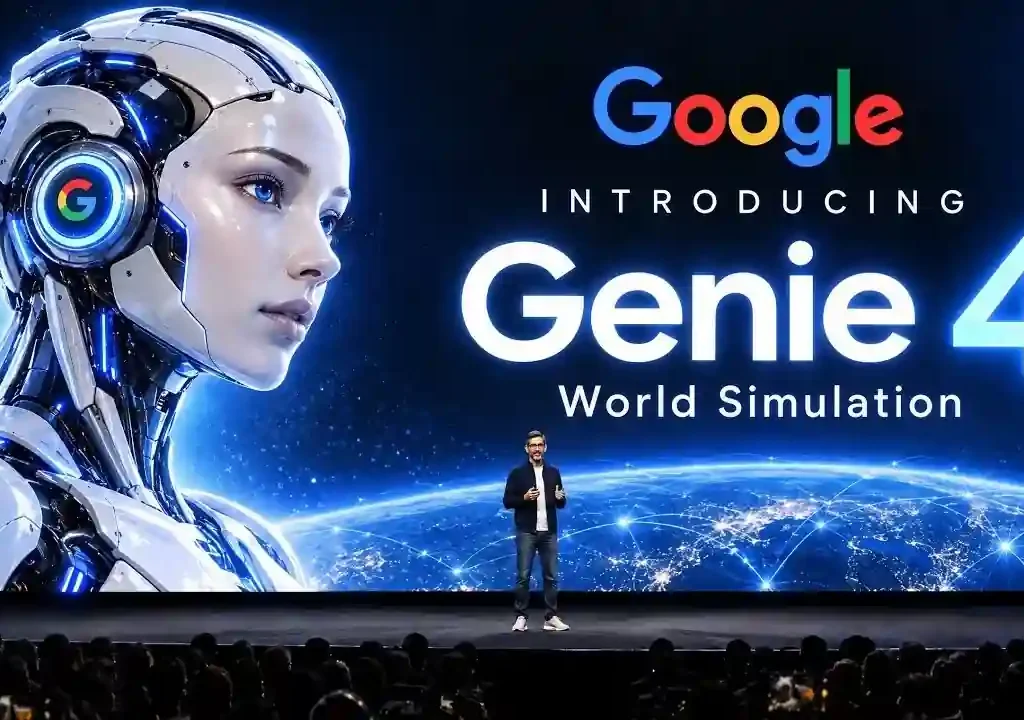
If a single text prompt can generate a walkable 3D environment complete with physics and talking characters, does traditional game development still have a future?
To understand this shift, you need to know what a world model actually does. Unlike standard AI video generators that spit out a fixed, unchangeable video clip, a world model renders reality one frame at a time based on your live keyboard inputs and text commands. It is the difference between watching a movie on a screen and physically stepping onto the movie set to move the props around.
How the Google Genie 4 World Model Works
Google DeepMind engineered this system to respond dynamically to human input rather than playing back a predetermined sequence. Users start with a text prompt describing a setting, camera angle, and mood. Once the simulation begins, you can walk around using standard keyboard controls while typing new instructions to alter the weather, spawn objects, or redirect characters mid-session.
Behind the scenes, the Google Genie 4 world model relies on an architectural tag-team from the broader Gemini ecosystem. Gemini Omni anchors the visual appearance and physical behavior of objects so water flows and trees sway realistically. Meanwhile, Gemini 3.8 Flash actively watches incoming frames, breaks complex goals into logical steps, and ensures cause-and-effect sequences stay coherent over time.
The biggest breakthrough in this release is the addition of native audio and realistic human motion. Previous world models struggled heavily with stiff character movement and operated in total silence. Now, generated people react naturally to your presence, hold interactive conversations, and exist within a rich soundscape of footsteps, wind, and background music.
Why Unreal Engine Is Not Dead Yet
Despite viral claims across social media, traditional game engines like Unreal Engine 5 are nowhere near extinction. Google DeepMind explicitly frames this technology as an early research preview designed for rapid prototyping, filmmaking previsualization, and robotics training. Building a commercial video game requires deterministic physics, rock-solid multiplayer netcode, and predictable frame rates that neural rendering cannot yet guarantee.
| Specification / Feature | Google Genie 4 (AI World Model) | Traditional Game Engines (Unreal Engine) |
|---|---|---|
| Core Architecture | Frame-by-frame neural simulation (Gemini Omni & 3.8 Flash) | Deterministic C++ rendering, rigid-body physics, and polygon meshes |
| Audio Generation | Native real-time ambient sound, music, and reactive dialogue | Pre-recorded audio assets, spatial mixers, and scripted voice lines |
| User Interaction | Live keyboard navigation plus mid-session text prompt edits | Hardcoded player mechanics, controllers, and compiled game logic |
| Visual Consistency | Prone to object permanence drift over extended sessions | 100% persistent geometry, lighting, and asset memory |
| Watermarking & Safety | Embedded with imperceptible SynthID on all audio and video | Standard digital rights management (DRM) and engine licensing |
| Availability & Pricing | Closed research preview; public waitlist via Project Genie ($0 / ₹0 / €0 / £0 currently) | Publicly available; free up to $1 million (approx. ₹8.4 crore / €920,000 / £790,000) gross revenue |
DeepMind has been remarkably transparent about the current technical ceilings of the Google Genie 4 world model. During longer play sessions or after multiple complex prompt edits, visual details and object permanence begin to drift. If you turn away from a specific building or object and look back thirty seconds later, the AI might subtly alter its shape or erase it entirely.
Furthermore, rendering legible text inside simulated environments remains a major hurdle, alongside spatial accuracy during complex physical collisions. DeepMind has also withheld official resolution metrics, target frame rates, and public API pricing. For reference, Google’s frontier Gemini 4 Argon text model currently carries an introductory rate of $2 (approx. ₹168 / €1.85 / £1.58) per million input tokens through November 30, 2026, signaling that real-time video-audio compute will eventually be expensive.
How Creators and Robotics Teams Use It Today
Even without commercial game-ready stability, trusted testers are already putting the Google Genie 4 world model to work across four distinct industries. Filmmakers use the platform as a live virtual soundstage to test camera angles, lighting setups, and actor blocking before spending money on physical sets. Photojournalists and educators are feeding single archival photographs into the system to transform static historical moments into explorable three-dimensional spaces.
In the enterprise sector, robotics researchers are pairing Genie 4 with Gemini 4 Argon to generate endless training scenarios. Instead of manually coding thousands of warehouse layouts or obstacle courses, engineers can prompt varied environments to test how autonomous machines react to unexpected hazards. Every single frame of video and second of audio generated during these tests carries Google’s imperceptible SynthID watermark to prevent misinformation.
The Bigger Picture
Google DeepMind is aggressively shifting the generative AI race away from passive content creation toward interactive spatial computing. By integrating reasoning models directly into pixel-level simulation, Google is putting immense pressure on rivals like OpenAI, Meta, and World Labs to move beyond simple text-to-video clips. While Epic Games and Unity do not need to worry about losing AAA studio contracts this year, the early previsualization and indie prototyping phases of game design are being permanently rewritten.
Unfiltered Opinion
Calling Unreal Engine dead because of Genie 4 is pure internet clickbait. Right now, this technology is a brilliant digital sketchpad rather than a finished game engine. If you are a film director, concept artist, or indie developer trying to pitch an idea without spending six months writing code, signing up for the Project Genie waitlist is an absolute no-brainer. However, if you want to ship a polished, bug-free game where a sword stays in a character’s hand for ten hours straight, traditional game engines remain completely irreplaceable.
- K.K., Founder of TechKomo