Fresh regulatory filings and supply chain whispers confirm that the iPad mini 8 leaks point toward the most radical hardware overhaul in the small tablet lineup’s history.
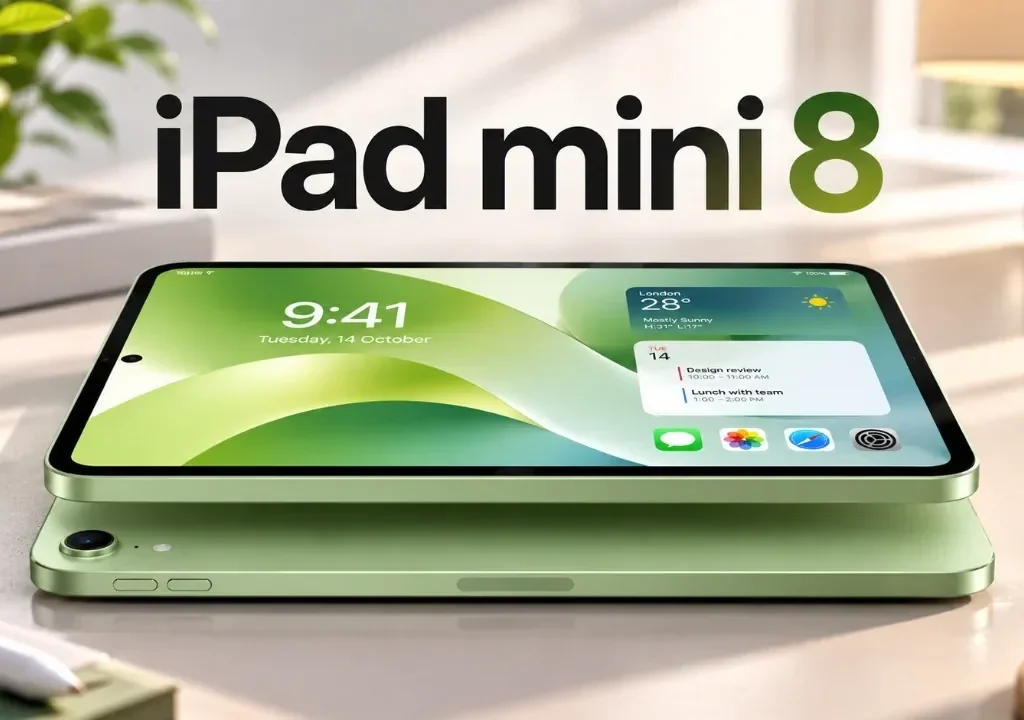
- Custom OLED Display Panel: Upgrading from the dated Liquid Retina LCD to an 8.4-inch OLED screen with infinite contrast ratios.
- Next-Gen A20 Pro Silicon: Moving to a cutting-edge 2nm processor architecture paired with 12GB unified RAM built explicitly for on-device Apple Intelligence.
- Chassis Redesign & Water Resistance: First-ever official IP rating for water resistance alongside a relocated landscape front FaceTime camera.
- Apple N1 Wireless Chip: Direct integration of Apple’s proprietary networking silicon introducing Wi-Fi 7 and Bluetooth 6 protocols.
TechKomo Disclaimer: The details discussed below are based on early industry leaks and regulatory filings. Official specifications and retail pricing may vary prior to the formal announcement.
Can an ultra-compact tablet truly justify a flagship price tag when modern smartphones are already crossing the seven-inch threshold?
In plain terms, shifting to an OLED panel means individual organic pixels switch off completely to produce pure ink-level blacks, entirely eliminating the annoying edge-bleed and “jelly scrolling” artifacts that plagued earlier generations.
Display Overhaul: Say Goodbye to Muddy LCD Blacks
Industry leaks suggest Apple is finally retiring traditional LED-backlit panels across its compact lineup in favor of an 8.4-inch OLED display.
Consequently, users will gain massive HDR highlights, true blacks, and dramatically wider color volume for media consumption.
Supply chain insiders indicate testing occurred for both 60Hz and 120Hz ProMotion panels, though Apple may limit the refresh rate to 60Hz to protect battery consumption within the tiny footprint.
Furthermore, trimming the outer bezel profile yields a larger viewable canvas while maintaining the identical hand-friendly footprint of 293g (10.33 oz).
Processing Muscle: The A20 Pro Leap and 12GB Unified RAM
Under the hood, supply chain tracking points to Apple’s unannounced A20 Pro chipset, fabricated on TSMC’s cutting-edge 2nm node.
Initial benchmark estimations suggest roughly 1.5× faster CPU performance and up to 2.5× faster GPU gains over the older A17 Pro platform.
Crucially, memory capacity reportedly expands from 8GB to 12GB of unified RAM.
This substantial RAM bump fuels a dual 16-core Neural Engine configuration designed specifically to run generative models and expressive voice synthesis locally without thermal throttling.
Therefore, creative workflows like 4K ProRes timeline editing and high-tier 3D gaming will no longer suffer from aggressive background app purging.
Redesigned Audio, Landscape Camera, and Built-In IP Durability
Beyond internal speeds, the physical chassis gains three notable structural refinements that change everyday usability.
The front-facing 12MP Ultra Wide camera moves from the portrait top to the right horizontal bezel, aligning video calls naturally in landscape orientation.
Simultaneously, acoustic engineers have reportedly removed external speaker grille cutouts, replacing them with a sealed border acoustic system that enables formal IP-certified water and dust resistance.
In addition, Apple’s proprietary N1 networking chip makes its debut here, delivering latency-free Wi-Fi 7 speeds and Bluetooth 6 standard compatibility.
| Specification | iPad mini 7 (Previous Gen) | iPad mini 8 (Expected Leaks) |
|---|---|---|
| Processor | Apple A17 Pro (3nm) | Apple A20 Pro (2nm) |
| Display | 8.3-inch Liquid Retina LCD (60Hz) | 8.4-inch OLED Panel (60Hz / ProMotion tested) |
| Unified Memory | 8GB RAM | 12GB RAM |
| Base Storage | 128GB | 128GB / 256GB tiers |
| Chassis Protection | None (Unrated) | Certified IP Water Resistance |
| Front Camera | Portrait 12MP FaceTime HD | Landscape 12MP Center Stage |
| Connectivity | Wi-Fi 6E / 5G | Apple N1 (Wi-Fi 7 / Bluetooth 6) |
| Weight | 293g (10.33 oz) | Approx. 290g–295g (10.2–10.4 oz) |
| Expected Price | $499 | $599 to $699 (approx. ₹51,900–₹60,500 / €560–€650 / £480–£560) |
Expected Launch Timeline and Global Pricing Realities
Supply chain chatter points toward an official reveal slated for late October, likely around October 27, 2026, with shipments commencing in mid-November.
Global keynote timings are expected around 10:00 AM PT / 1:00 PM ET / 5:00 PM GMT.
Due to escalating wafer fabrication expenses and the introduction of custom OLED glass, base pricing will likely command a bump.
Expect the entry model to land around $599 to $699 (approx. ₹51,900–₹60,500 / €560–€650 / £480–£560) for the standard Wi-Fi tier.
These price points certainly push the mini away from entry-level buyers into specialized luxury utility.
The Bigger Picture
This sudden push into premium hardware signals a direct strike against high-end Android foldables that are increasingly siphoning off tablet screen time.
By cramming an OLED panel, IP resistance, and 2nm desktop-grade silicon into an eight-inch frame, Apple effectively converts a neglected niche tablet into an uncompromising pocket workstation.
This move puts immense pressure on rivals to abandon cut-corner specs in the compact tablet segment entirely.
Unfiltered Opinion
For years, Apple treated the mini lineup like a neglected afterthought, rationing out display innovations and leaving users to endure irritating scrolling stutter.
These newest leaks prove Cupertino finally realizes that small tablet enthusiasts are power users who want flagship power rather than bargain-bin cost cutting.
If you already own an older model and crave pure black levels for late-night reading or flight entertainment, this upgrade will be entirely worth saving for.
However, if Apple decides to lock the panel at 60Hz while demanding a steep price bump, that missed opportunity will sting for another two-year hardware cycle.
- K.K., Founder of TechKomo