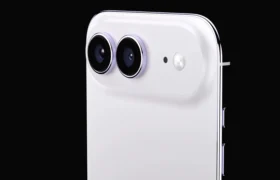
The launch of the iPhone Duo foldable design proves that Apple chose patience over hurried gimmicks.
- A Decade in the Making: Apple filed its foundational flexible hardware patents back in 2011 before committing to production.
- Crease-Free Ambition: A proprietary hinge packing over 100 precision components completely eliminates the traditional visual trench.
- Flagship Silicon: Powered by the 3nm A20 Pro chip paired with a custom internal vapor chamber.
- Premium Entry: Global pricing begins at $1,999 / €2,199 / £1,899 with pre-orders live today.

Can Cupertino really justify a five-year delay by simply engineering away a screen crease?
In simple terms, folding glass naturally wrinkles when bent repeatedly, much like folding a thick plastic card.
Instead of settling for off-the-shelf polymer films, Apple developed an ultra-thin custom glass blend treated with surface nanotexture to keep the display completely flat.
Speaking in a detailed interview, Apple CEO John Ternus explained why Cupertino sat on the sidelines while Android manufacturers rolled out early bending flagships.
According to Ternus, early market entries felt somewhat compromised and fragile, lacking the structural integrity required of an everyday flagship.
Hardware VP Richard Dinh revealed that engineering teams were told to reject “good enough” materials until they created a hinge mechanism that held up under relentless friction.
Consequently, the iPhone Duo foldable design relies on an intricate mechanical spine using hardened titanium alloys to distribute inward tension evenly.
Externally, users interact with a 5.4-inch outer OLED panel that mimics standard passport ergonomics.
Unfolding the chassis reveals an expansive 7.6-inch inner Super Retina XDR display operating at 120Hz ProMotion.
Weighing in at 238g (8.39 oz), the chassis measures just 4.9mm when open and 10.2mm when shut.
Under the hood, benchmark figures show the A20 Pro processor delivering a 28% jump in sustained multi-core performance over preceding silicon.
Global pre-orders began promptly at 5:00 AM PT / 8:00 AM ET / 1:00 PM GMT on October 16, 2026, ahead of retail availability on October 23, 2026.
| Feature | Official Specification |
|---|---|
| Processor | Apple A20 Pro (3nm) with Vapor Chamber Cooling |
| Inner Display | 7.6-inch Foldable OLED, 120Hz ProMotion, 2,600 nits peak |
| Outer Display | 5.4-inch OLED Cover Screen, 120Hz refresh rate |
| Hinge Mechanism | Zero-gap dual-pivot titanium hinge with 100+ precision parts |
| Battery & Charging | 4,850mAh dual-cell; 50% wired charge in 20 minutes |
| Cameras | Dual 48MP Fusion main array + 12MP under-display front camera |
| Starting Price | $1,999 (US) / €2,199 (EU) / £1,899 (UK) |
Industry leaks suggest Apple postponed mass production twice between 2023 and 2025 specifically because hinge cycle tests failed strict internal drop standards.
Supply chain insiders indicate that panel yields have finally crossed 88%, allowing global logistics pipelines to fulfill launch day demand.
Software integration also plays an enormous role through customized split-screen multitasking built into iOS 27.
The broader market implications are massive, forcing established rivals to rethink their hinge ergonomics and crease tolerance immediately.
By waiting until the hardware felt uncompromising, Apple effectively reset consumer expectations around how a dual-screen device ought to feel in hand.
The iPhone Duo foldable design is undeniably an engineering masterclass, but that steep entry ticket means early adopters are paying heavily for perfection.
If you value seamless productivity without the ugly visual trough of older hinges, this hardware easily delivers the best experience money can buy today.
- K.K., Founder of TechKomo