Early engineering leaks indicate that the Samsung Galaxy Z Fold 9 could completely derail Apple’s momentum in the ultra-premium foldable space.
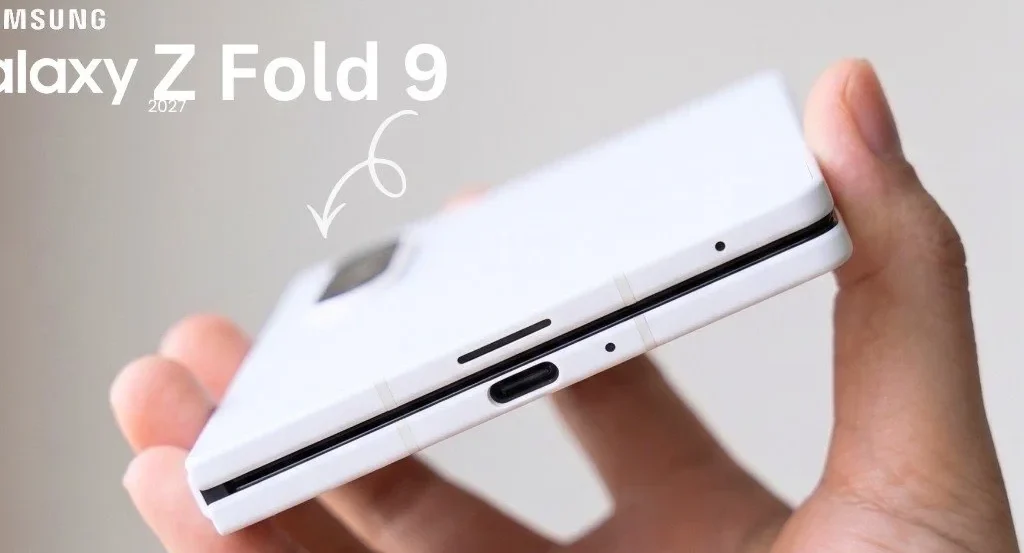
- Leaked blueprints point to a razor-thin chassis measuring just 3.9mm unfolded and 7.9mm folded.
- Samsung Display is developing center-etched thin glass (CTG) to practically eliminate the inner screen crease.
- Upgraded silicon targets Qualcomm’s next-generation 2nm flagship processor alongside potential 60W fast charging.
- Enhanced durability targets include a full IP68 rating and the return of an invisible under-display camera.
Will Apple’s newly launched foldable remain relevant once Samsung unleashes this ultra-slim redesign?
In simple terms, folding glass has always required a compromise between durability and a visible crease indentation.
Samsung’s next panel chemically etches only the central bend axis, allowing the screen to bend seamlessly while keeping the surrounding glass thick and shatter-resistant.
TechKomo Disclaimer: The details discussed below are based on early industry leaks and rumors. Official specifications may vary.
The Radical Slimming Race: 7.9mm Engineered Precision
Supply chain insiders indicate that Samsung engineers are pursuing an ambitious physical footprint.
Early prototypes reveal an unfolded thickness of just 3.9mm (0.15 inches).
When closed shut, the device reportedly shrinks down to a compact 7.9mm (0.31 inches).
To put that into perspective, previous generations hovered closer to 9.7mm, while rival hardware often exceeds 11.3mm.
Furthermore, internal targets suggest a featherlight chassis weighing roughly 195g to 200g (6.88 to 7.05 oz).
Achieving this profile requires a radical overhaul of the multi-gear hinge mechanism.
Engineers have reportedly trimmed excess metal brackets without compromising structural torsional stiffness.
Consequently, the handset feels virtually identical to a standard glass slab when slipped into your pocket.
Display Breakthrough: Erasing the Visible Crease
Foldable displays have reached an inflection point where simple hinge adjustments are no longer sufficient.
Display division leaks suggest that Samsung is moving away from uniform ultra-thin glass.
Instead, the new device leverages center-etched thin glass, or CTG technology.
This fabrication technique chemically polishes the exact bend radius of the inner OLED panel.
Because the glass remains thicker on the outer edges, tactile rigidity stays exceptionally high.
Meanwhile, the central crease valley flattens out almost entirely under direct room lighting.
Therefore, users will no longer catch the distracting reflections that plagued earlier generations.
Industry leaks also hint at the return of an improved under-display camera for an uninterrupted visual canvas.
Silicon Upgrades: 2nm Efficiency and Faster Power Delivery
Under the hood, early supply chain chatter points to Qualcomm’s upcoming 2nm node silicon.
This customized platform aims to dramatically improve sustained thermal efficiency in ultra-slim chassis designs.
Because battery physical depth is constrained by the 3.9mm unfolded profile, density optimizations are mandatory.
Engineers are reportedly testing split dual-cell configurations totaling roughly 4,900mAh to 5,100mAh.
Moreover, testing benchmarks indicate Samsung may finally adopt 60W wired charging.
That marks a notable jump from the traditional 45W ceiling on predecessor models.
Wireless charging speeds are also expected to hit 15W, backed by enhanced inductive copper coils.
| Specification | Samsung Galaxy Z Fold 9 (Projected) | Predecessor Baseline (Galaxy Z Fold 8) |
|---|---|---|
| Processor | Next-Gen 2nm Qualcomm Snapdragon Flagship | Snapdragon 8 Elite Gen 5 for Galaxy |
| Display (Inner) | 7.6-inch to 8.0-inch 120Hz LTPO Dynamic AMOLED with CTG | 120Hz LTPO AMOLED (Uniform UTG) |
| Thickness (Folded) | 7.9mm (0.31 inches) | 9.7mm (0.38 inches) |
| Thickness (Unfolded) | 3.9mm (0.15 inches) | 4.5mm (0.18 inches) |
| Battery & Charging | Approx. 5,000mAh with 60W wired / 15W wireless | 4,800mAh with 45W wired |
| Camera Setup | 200MP Main + 50MP Ultra-Wide + 50MP Periscope Telephoto | 50MP Main + 12MP Ultra-Wide + 10MP Telephoto |
| Durability Rating | Target IP68 dust and water resistance | IP48 water resistance |
| Projected Price | Starting at $1,899 (approx. ₹1,58,000 / €1,730 / £1,500) | Starting at $1,899 (approx. ₹1,58,000 / €1,730 / £1,500) |
Durability Leaks: Eyeing the Full IP68 Milestone
Dust protection remains the ultimate hurdle for complex folding hinges.
Previous models carried an IP48 certification, which offered zero defense against fine microscopic debris.
Supply chain reports reveal that Samsung wants a verified IP68 rating across the upcoming lineup.
New internal micro-bristles and sealed silicone gaskets prevent grit from entering the spine gears.
Additionally, chassis designers are testing a reinforced Armor Aluminum composite combined with ceramic back panels.
Stylus support is another critical front where rumors are actively heating up.
While recent models bypassed internal S Pen holsters to save thickness, digitizer tech is advancing rapidly.
If Samsung embeds a thinner active digitizer, productivity enthusiasts could see digital pen input fully restored.
The Bigger Picture
The rapid evolution behind the Samsung Galaxy Z Fold 9 sends a warning flare directly toward Cupertino. With early foldable entrants fighting for market dominance, Apple’s bulky form factors suddenly face a massive industrial design deficit. If Samsung successfully delivers a sub-8mm device with an invisible crease and full water resistance, it effectively renders first-generation rival hardware dated before it even gains mainstream traction.
Unfiltered Opinion
Let us be completely transparent about what is happening here.
Samsung spent years resting on its laurels with incremental hinge tweaks and conservative battery upgrades.
However, genuine competitive pressure from aggressive global rivals has forced the company back into real engineering innovation.
If this 7.9mm chassis target and creaseless CTG glass actually survive mass production, it will be the most compelling hardware leap since the original Fold.
Nevertheless, skepticism is warranted until retail units hit the test bench.
Chemically etching the center of ultra-thin glass is notorious for creating optical distortion if the polishing process deviates by mere micrometers.
If you already own a capable flagship foldable, do not rush to empty your wallet just yet.
Wait until official production yields confirm whether that crease is truly dead, or just temporarily masked under ideal showroom lighting.
- K.K., Founder of TechKomo