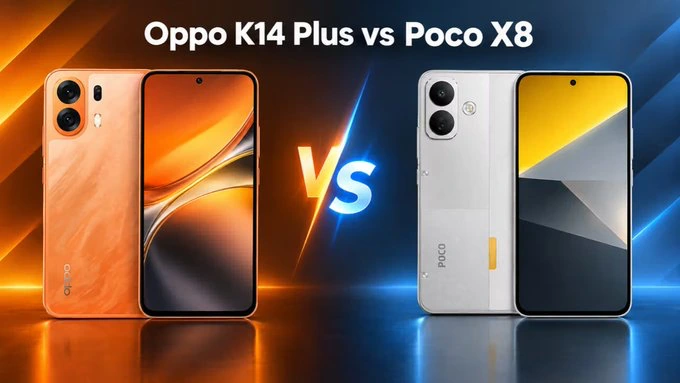
Choosing between the OPPO K14 Plus vs POCO X8 could make or break your smartphone upgrade this season.
Quick Highlights
- Massive Battery Showdown: OPPO pushes endurance limits with a colossal 9,000mAh battery versus POCO’s balanced 6,500mAh cell.
- Display Supremacy: POCO targets competitive gamers with an ultra-fluid 144Hz AMOLED panel against OPPO’s standard 120Hz refresh rate.
- Next-Gen Software: Both devices are slated to debut near the rollout of Android 17, promising multi-year update roadmaps.
- Aggressive Mid-Range Pricing: Early estimates place both contenders in the tight $280 to $340 (€260 – €315 / £220 – £270) bracket.
TechKomo Disclaimer: The details discussed below are based on early industry leaks and rumors. Official specifications may vary.
Will you prioritize three-day battery life, or does silky gaming performance matter more to you?
In practical terms, refresh rate dictates how fluid screen animations appear, while battery capacity measures how long your handset runs without a charger.
OPPO K14 Plus vs POCO X8: The Battery Capacity Showdown
Battery longevity has become the central battlefield in the value-oriented market segment.
Supply chain insiders indicate that OPPO is attempting a historic milestone with a silicon-carbon 9,000mAh battery.
Consequently, that massive pack could deliver up to three full days of heavy use on a single charge.
In contrast, leaked schematics suggest POCO has chosen a lighter, high-density 6,500mAh battery configuration.
Moreover, the POCO device compensates for capacity with rapid 90W fast charging, hitting full power in under 40 minutes.
Meanwhile, OPPO matches this pace with proprietary 80W wired charging, though charging that enormous cell naturally requires more patience.
As a result, frequent travelers might naturally lean toward the endurance monster.
Display Wars: Can 144Hz Outshine OPPO’s Panel?
Visual performance marks the sharpest philosophical difference between these two devices.
Specifically, early retail listings show POCO equipping its device with a flagship-grade 6.67-inch 1.5K 144Hz AMOLED panel.
That heightened refresh rate guarantees smoother touch response during competitive online gaming sessions.
Conversely, the rival handset reportedly packs a slightly larger 6.78-inch Full HD+ 120Hz OLED display.
However, OPPO claims an impressive peak brightness of 2,600 nits for stellar outdoor visibility under direct sunlight.
Therefore, your choice rests between competitive gaming speed and raw, punchy outdoor readability.
Processing Power and the Android 17 Advantage
Performance enthusiasts will find intriguing choices under the hood of both machines.
Industry leaks point to the POCO device harnessing the cutting-edge MediaTek Dimensity 8450 chipset.
Consequently, early benchmark projections show multi-core Geekbench scores climbing comfortably beyond 4,200 points.
On the other hand, reports suggest OPPO relies on a custom-tuned Qualcomm Snapdragon 7+ Gen 4 processor.
Furthermore, both platforms will arrive deeply integrated with software skins optimized for Android 17.
This forward-looking software foundation promises upgraded privacy sandboxes and streamlined generative background tasks.
Additionally, both manufacturers plan to guarantee at least 3 major OS upgrades alongside 4 years of security patches.
Flexible Hardware Comparison
| Feature | OPPO K14 Plus (Rumored) | POCO X8 (Rumored) |
|---|---|---|
| Processor | Qualcomm Snapdragon 7+ Gen 4 | MediaTek Dimensity 8450 |
| Display | 6.78-inch 120Hz OLED (2,600 nits) | 6.67-inch 1.5K 144Hz AMOLED (3,000 nits) |
| Battery | 9,000mAh silicon-carbon | 6,500mAh high-density |
| Charging Speed | 80W wired | 90W wired |
| Rear Cameras | 50MP main (OIS) + 8MP ultra-wide | 64MP main (OIS) + 8MP ultra-wide + 2MP macro |
| Weight | 224g (7.90 oz) | 198g (6.98 oz) |
| Software | ColorOS based on Android 17 | HyperOS based on Android 17 |
| Estimated Base Price | ~$310 (€290 / £245) | ~$290 (€270 / £230) |
Camera Capabilities and Everyday Ergonomics
Megapixel counts alone never guarantee superior photography.
Accordingly, the OPPO model leans on an upgraded 50MP Sony IMX primary sensor equipped with robust optical image stabilization.
Meanwhile, POCO counters with an aggressive 64MP primary shooter, tuned aggressively for vivid social media snapshots.
Nevertheless, ergonomic differences between the two phones will be impossible to ignore in daily handling.
Because of that gargantuan power cell, OPPO’s chassis weighs in at approximately 224g (7.90 oz).
Alternatively, POCO maintains a sleeker profile, tipping the scales at a pocket-friendly 198g (6.98 oz).
Thus, users with smaller hands may find one-handed usage distinctly easier on the POCO variant.
The Bigger Picture
This clash highlights a seismic shift occurring across the global mid-range smartphone segment.
Manufacturers are no longer content offering minor iterative camera updates; instead, they are deploying extreme hardware—such as pocket power banks and esport-grade screens—to undercut established rivals like Samsung and Motorola.
Unfiltered Opinion
If you spend your days on cross-country transit or off-grid adventures, OPPO’s relentless battery focus makes it an absolute marvel.
However, carrying a noticeably hefty phone everywhere quickly becomes tiresome during daily errands.
For the vast majority of regular buyers, POCO’s lighter frame, sharper panel, and faster charging strike the superior everyday balance.
Do not sacrifice daily comfort simply for battery capacity you might rarely fully drain.
- K.K., Founder of TechKomo