Can the new Samsung Galaxy F70 5G processor performance truly handle aggressive daily workloads without annoying micro-stutters?
- Samsung Exynos 1330 octa-core silicon clocked up to 2.4GHz drives daily operations.
- Entry-level configurations pack 4GB or 6GB RAM alongside 128GB expandable storage.
- Massive 5000mAh battery with 25W fast wired charging keeps the device running all day.
- Retail pricing lands in India at ₹19,999 (roughly $240 / €220 / £190), with introductory discounts hitting ₹17,999.
Will this silicon hold its ground under real-world multi-app stress, or does it throttle when pushed?
In plain terms, a processor acts as the phone’s engine, determining how quickly apps load and how smooth animations feel.
Architecture Behind Samsung Galaxy F70 5G Processor Performance
The heart of this handset relies on Samsung’s in-house 5nm Exynos 1330 octa-core chipset.
Architecturally, the setup features two high-performance ARM Cortex-A78 cores running at 2.4GHz.
Six energy-efficient ARM Cortex-A55 cores hum along at 2.0GHz for background processing.
Consequently, basic UI navigation and standard system tasks trigger only the low-power cluster to save battery.
Graphics workloads are offloaded to a competent dual-core Mali-G68 MP2 GPU.
Daily Productivity Speed And App Switching Realities
Everyday navigation feels snappy thanks to the synergy between hardware and a responsive 90Hz Super AMOLED panel.
Launching social media feeds, mapping GPS routes, and streaming high-definition video happen without noticeable delays.
However, system responsiveness depends heavily on which memory variant you select.
The base 4GB RAM variant quickly runs out of headroom when keeping multiple heavy apps alive in memory.
Android aggressively closes background processes on the base model to preserve resources.
Stepping up to the 6GB RAM tier delivers a noticeably smoother multi-window experience.
Virtual RAM expansion helps slightly, but physical memory always dictates true multitasking longevity.
Heavy Gaming Endurance And Thermal Behavior
Casual gaming runs effortlessly, maintaining stable frame rates in titles like Subway Surfers and Candy Crush.
Demanding 3D titles require compromise on this silicon.
Battle royale games run reliably only when dialed down to medium graphic settings.
Benchmark sweeps on the Exynos 1330 reveal an average AnTuTu score hovering around 410,000 to 430,000 points.
Geekbench single-core numbers hit roughly 920, while multi-core runs score close to 2,150.
Thermal management remains stable during moderate use because of the efficient 5nm fabrication node.
Extended thirty-minute gaming sessions do warm the chassis around the camera module, yet frame drops stay minimal.
| Hardware Specification | Galaxy F70 5G Configuration Details |
|---|---|
| Processor | Samsung Exynos 1330 (5nm, Octa-Core up to 2.4GHz) |
| GPU | Mali-G68 MP2 |
| Display | 6.7-inch Super AMOLED, FHD+, 90Hz refresh rate |
| Memory & Storage | 4GB / 6GB RAM, 128GB storage (MicroSD expandable) |
| Battery & Charging | 5000mAh, 25W fast charging (adapter sold separately) |
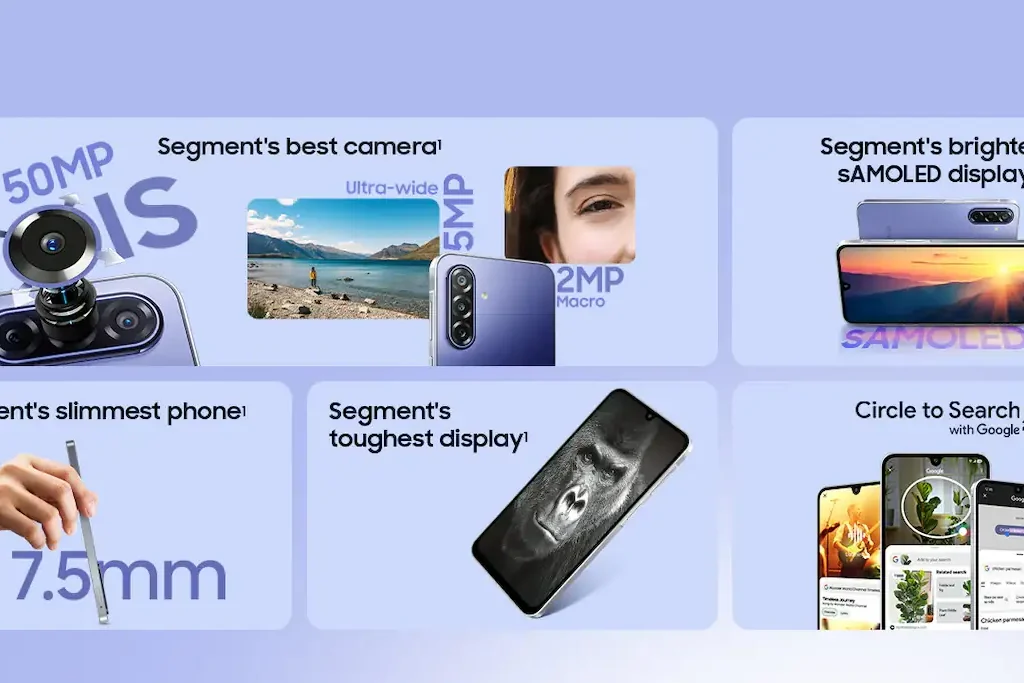
| Rear Cameras | 50MP main (OIS) + 5MP ultra-wide + 2MP macro |
| Front Camera | 13MP selfie shooter |
| Weight & Dimensions | 192g (6.77 oz), 7.5mm slim profile |
| Software Support | Android 14 / One UI Core, multi-year update roadmap |
| Global Pricing | Starts at ₹19,999 (~$240 / €220 / £190) |
The Bigger Picture
Samsung aims straight at aggressive competitors like Tecno, Realme, and Xiaomi in the cutthroat sub-$250 category.
Offering an in-house 5nm chip paired with optical image stabilization (OIS) forces rival brands to rethink their component budgets.
This launch strengthens Samsung’s grasp over developing markets where consumers demand modern 5G efficiency without paying flagship prices.
Unfiltered Opinion
Samsung built a sensible workhorse, but you must avoid the base configuration.
Buying the 4GB RAM version at ₹19,999 is a mistake if you intend to keep this device for several years.
Spend the extra cash on the 6GB RAM variant to give the chipset breathing room for future OS upgrades.
If your daily life revolves around emails, social feeds, and light productivity, this phone will not disappoint.
Hardcore competitive gamers, however, should look toward performance-first silicon alternatives elsewhere in this price tier.
- K.K., Founder of TechKomo