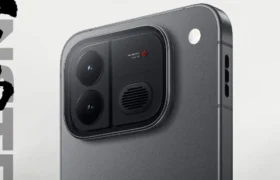
Fresh supply chain whispers reveal an unexpected iPhone 20 Pro Max upgrade that completely upends what fans anticipated for Apple’s landmark release.
- Apple plans to bypass standard naming cycles to launch the milestone device for the iPhone’s 20th anniversary.
- New CAD schematics indicate an expansive 6.96-inch quad-curved glass display with optical refraction borders.
- Flagship under-display camera dreams hit a brick wall, keeping the familiar Dynamic Island cutout firmly in place.
- Early manufacturing projections suggest a record baseline price tag starting well above $1,299 (€1,199 / £1,049).
Can Apple really justify an ultra-premium anniversary price when its most requested display innovation remains missing?
In simple terms, a quad-curved front panel bends glass on every perimeter edge to bend light optically.
Consequently, this creates the visual illusion of zero borders without exposing the delicate underlying pixel grid.
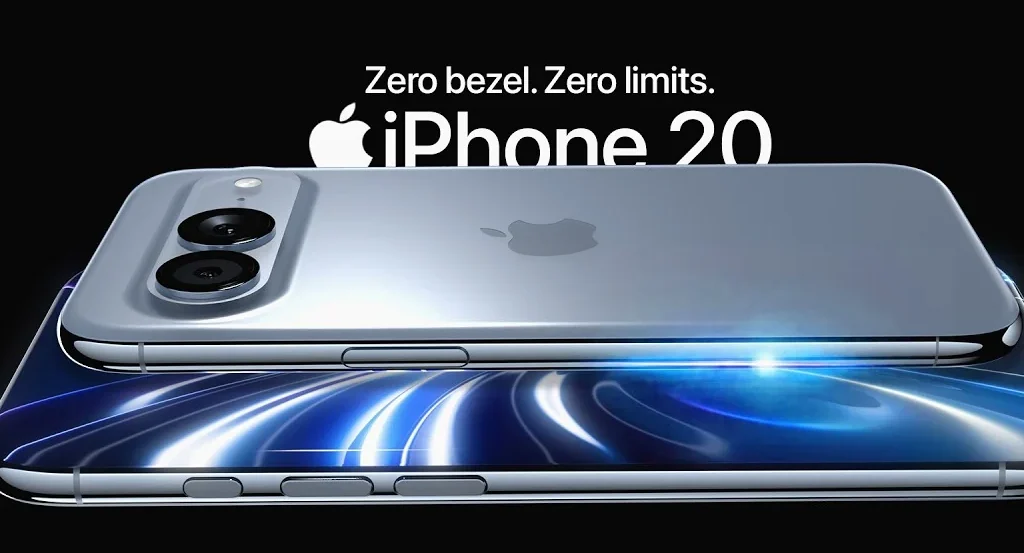
TechKomo Disclaimer: The details discussed below are based on early industry leaks and rumors. Official specifications may vary.
The Shocking Reality of the iPhone 20 Pro Max Upgrade
Enthusiasts long anticipated a monolithic, uninterrupted slab of glass for this special milestone device.
However, supply chain insiders indicate that full under-screen biometric arrays will miss the anniversary target window entirely.
Engineering teams faced severe degradation when routing infrared facial mapping beams through active OLED layers.
Furthermore, prototype selfie sensors struggled with chronic haze and a sharp drop in light throughput.
Because visual fidelity remains non-negotiable for flagship hardware, designers chose to retain the physical Dynamic Island cutout.
Therefore, the upcoming generation focuses its aesthetic transformation on structural glass curvature rather than hidden cameras.
Radical Quad-Curved Glass Without the Accidental Touches
Display engineers are testing a massive 6.96-inch front panel that slopes across all four outer borders.
Earlier Android implementations of waterfall panels suffered from phantom palm inputs and fragile glass corners.
In contrast, fresh lab testing reveals Apple utilizes a flat active digitizer paired with a molded top crystal.
Specialized optical refraction within the glass bends incoming photons outward toward the titanium chassis.
As a result, users get the visual thrill of an edge-free panel while keeping flat screen touch precision intact.
Moreover, the overall chassis footprint remains nearly identical to prior models despite the screen expansion.
Silicon Powerhouse and New Thermal Realities
Under the hood, the anniversary flagship is slated to debut the cutting-edge 2nm A21 Pro silicon.
Early architectural projections point to a 15% leap in single-core speeds alongside a 28% boost in power efficiency.
Additionally, internal testing sheets reference a bespoke vapor chamber cooling system built from sintered titanium powder.
This thermal solution dissipates heat faster during sustained generative processing and native console-tier gaming sessions.
Meanwhile, physical weight is rumored to land at approximately 224g (7.90 oz), maintaining a balanced in-hand feel.
Battery capacity is tracking toward an upgraded 5,120mAh cell to sustain the ultra-bright panel easily.
| Specification | Leaked iPhone 20 Pro Max Target |
|---|---|
| Processor | Apple A21 Pro (2nm node) |
| Display | 6.96-inch Quad-Curved OLED, 120Hz ProMotion |
| Peak Brightness | 3,200 nits outdoor peak |
| Biometrics | Dynamic Island with TrueDepth Face ID |
| Rear Cameras | Triple 48MP array with continuous optical prism zoom |
| Chassis Material | Polished Titanium-Glass Hybrid |
| Weight | 224g (7.90 oz) |
| Battery Capacity | 5,120mAh with 45W wired fast charging |
| Projected Price | $1,299 / €1,199 / £1,049 |
| Expected Reveal | September launch window (10:00 AM PT / 1:00 PM ET / 5:00 PM GMT) |
The Global Pricing Dilemma
Skyrocketing fabrication costs for dense semiconductor wafers continue to rattle global consumer electronics pricing tiers.
Consequently, industry watchers warn that the base configuration will command at least $1,299 across American retail channels.
European buyers should brace for stickers hovering around €1,199, while British shoppers will likely see £1,049.
Higher memory bandwidth requirements for onboard intelligence models directly amplify these baseline component bills.
Nevertheless, premium flagship buyers historically swallow modest price hikes when external styling looks distinctly new.
The Bigger Picture
This radical design shift signals a critical strategic pivot across the broader smartphone landscape.
Rival manufacturers spent years abandoning curved screens to cut repair claims and simplify assembly lines.
Now, Cupertino’s re-imagining of curved refraction glass forces competitors to reconsider their flat slab trajectories.
It turns aesthetic surface styling into a status symbol once again while true under-display tech matures.
An Unfiltered Take on the Leaks
Skipping ahead to celebrate an anniversary with curved glass borders feels undeniably flashy, but it comes with caveats.
If this iPhone 20 Pro Max upgrade keeps the Dynamic Island pill, it proves that physics still defeats marketing ambition.
Charging top dollar for optical tricks instead of delivering a genuine all-screen experience might alienate purists.
Still, the sheer processing muscle and borderless illusion will undoubtedly trigger massive carrier upgrade queues worldwide.
- K.K., Founder of TechKomo