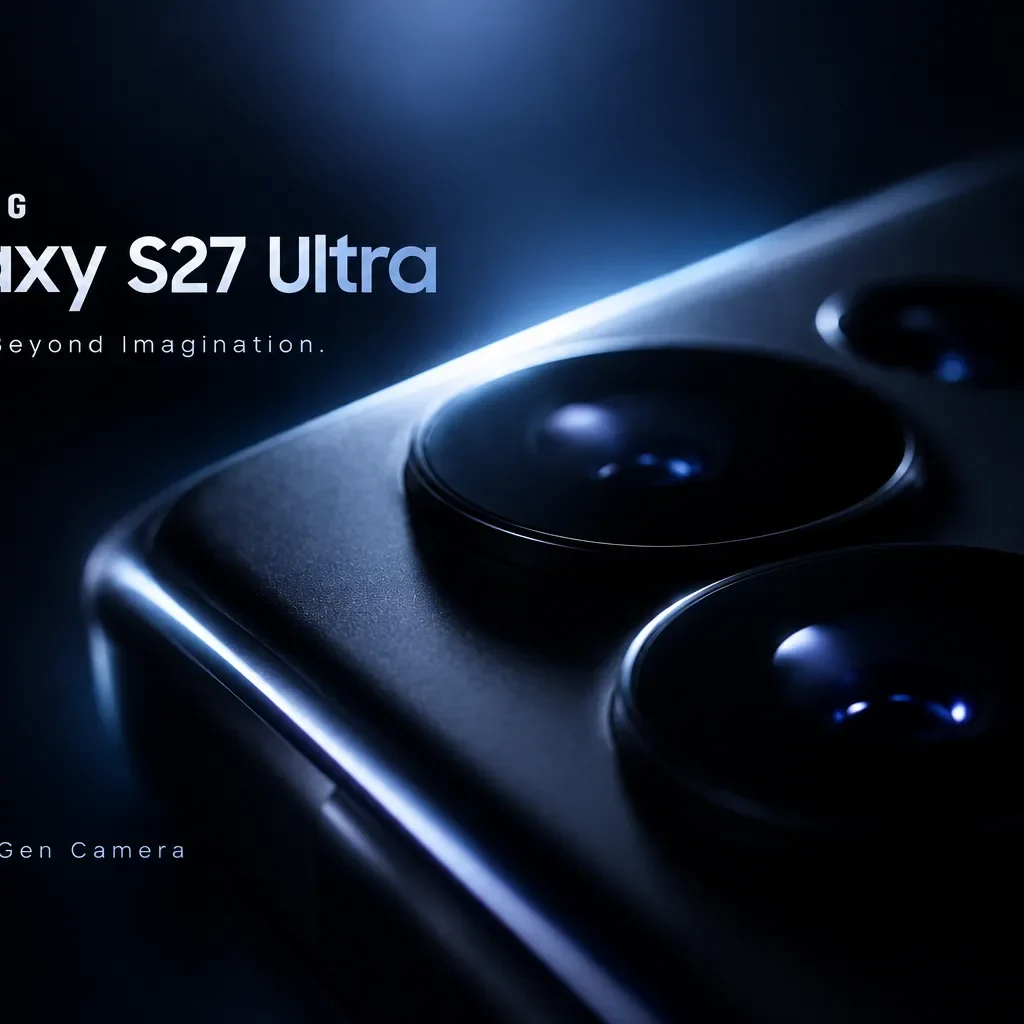
Fresh supply chain leaks reveal that the upcoming Samsung Galaxy S27 Ultra camera overhaul could finally end mobile photography limitations.
- A next-generation 200MP ISOCELL HP6 primary sensor headlines the incoming setup.
- Leaks suggest Samsung will eliminate the dedicated 3x telephoto lens entirely.
- High-magnification tasks shift to a massive 50MP periscope zoom system.
- Hardware-level dynamic range promises to resolve persistent low-light sensor noise.
Will cutting an optical zoom lens actually give mobile photographers sharper images?
This overhaul centers on sensor-crop zoom, which uses high-resolution centers of massive sensors instead of dedicated secondary lenses.
TechKomo Disclaimer: The details discussed below are based on early industry leaks and rumors. Official specifications may vary.
The Next-Gen 200MP ISOCELL Sensor Upgrade
Industry sources confirm that Samsung is preparing a revised 200MP ISOCELL HP6 imager.
While raw megapixel counts stay identical, physical architecture undergoes substantial refinements.
The redesigned silicon expands full-well capacity to control overblown highlights in harsh daylight.
Furthermore, updated sub-pixel deep trench isolation reduces color crosstalk across adjacent pixels.
Consequently, photos taken in challenging conditions exhibit significantly cleaner edges.
Hardware-level processing optimizations also tackle motion blur, a persistent complaint among smartphone photographers.
Earlier iterations struggled to freeze moving subjects inside dimly lit rooms.
This updated configuration leverages accelerated readouts to sample light without degrading exposure balance.
Killing the 3x Lens: The New Zoom Math
Supply chain blueprints reveal an unexpected shift in the rear camera assembly.
The traditional 10MP 3x optical module appears completely eliminated from testing schedules.
Instead, intermediate portraits rely entirely on lossless in-sensor cropping from the primary 200MP unit.
A massive 50MP periscope zoom camera handles extreme distances using a native 5x optical focal length.
This sensor upgrade captures noticeably sharper textures than aging small-format optical glass.
Moreover, consolidating physical modules frees up vital chassis volume inside the frame.
Engineers can reallocate this space toward a denser 5,700mAh silicon-carbon battery pack.
Chassis measurements tighten to 163.76 x 78.25 x 7.97 mm, maintaining a total weight of 218 grams.
| Camera Module | Leaked Hardware Specs | Primary Optical Role |
|---|---|---|
| Primary Wide | 200MP ISOCELL HP6 | Standard wide shots and 1x to 4x digital crop |
| Ultra-Wide | 50MP, f/2.0 aperture | Ultra-wide landscape scenes and macro photography |
| Periscope Telephoto | 50MP, 5x optical zoom | Distant subjects and computational 100x Space Zoom |
| Front Selfie | 16MP, PDAF autofocus | Crisp portrait captures and 4K 60fps video |
Why Sensor Cropping Surpasses Small Optical Lenses
Modern mobile computational pipelines process multi-frame RAW bursts with microsecond precision.
A large 200MP sensor gathers more photon data across a cropped center than tiny 10MP optical sensors.
Therefore, portraits taken at 3x magnification retain natural depth without excessive digital sharpening.
Samsung also pairs the rear cluster with an upgraded 50MP ultrawide camera.
This setup creates unified color profiles across every single focal length.
Global Release Timelines and Flagship Pricing
Insiders expect Samsung to unveil its next flagship lineup during an Unpacked event in February 2027.
Global livestreams typically begin at 10:00 AM PT (1:00 PM ET / 6:00 PM GMT).
Baseline retail pricing for the flagship tier remains projected at $1,299 USD.
Powering the international variants will likely be the cutting-edge 2nm Snapdragon 8 Elite silicon.
Selected global regions may alternatively receive commercial shipments featuring the in-house 2nm Exynos 2700 processor.
Both silicon platforms support high-throughput image signal pipelines essential for handling 200MP RAW data.
Display hardware centers on an expansive 6.9-inch QHD+ LTPO OLED panel pushing fluid 120Hz refresh rates.
Memory standards climb to 16GB LPDDR6 RAM, paired with ultra-fast UFS 5.0 storage.
The Bigger Picture
This radical reconfiguration marks an aggressive countermeasure against fierce Chinese imaging flagships and Cupertino’s telephoto advances. By abandoning redundant secondary lenses in favor of high-density crop sensors, Samsung is pioneering a leaner hardware model that prioritizes internal chassis thermal efficiency and massive silicon-carbon battery capacities without sacrificing high-magnification reach.
My Take
Ditching a physical 3x telephoto lens sounds counterintuitive on paper, yet it represents the smartest hardware decision Samsung has weighed in years. Forcing a massive 200MP sensor to shoulder intermediate zoom workloads eliminates unnecessary optical clutter while delivering superior light collection. If Samsung pairs this streamlined hardware with refined shutter latency algorithms, the Samsung Galaxy S27 Ultra camera will finally reclaim undisputed dominance in real-world mobile photography.
- K.K., Founder of TechKomo