The battle between the Galaxy S26 Ultra vs iPhone 18 Pro Max proves that paper benchmarks no longer decide real-world smartphone supremacy.
On paper, raw megapixels and clock speeds suggest an easy blowout.
Yet, the actual daily experience exposes a completely different hierarchy once these heavyweights clash in your hand.
- Sustained Endurance: The iPhone 18 Pro Max edges ahead with an active run time of 19 hours and 20 minutes against Samsung’s 16 hours and 22 minutes.
- Camera Architecture: Apple introduced a hardware variable aperture (f/1.48 to f/4.0), challenging Samsung’s brute-force 200MP sensor.
- Silicon Efficiency: The 2nm A20 Pro chip sets new efficiency standards against Qualcomm’s 3nm Snapdragon 8 Elite Gen 5.
- Ergonomic Contrast: Samsung trims its chassis to 214g (7.55 oz), making Apple’s dense 249g (8.78 oz) frame feel heavy.
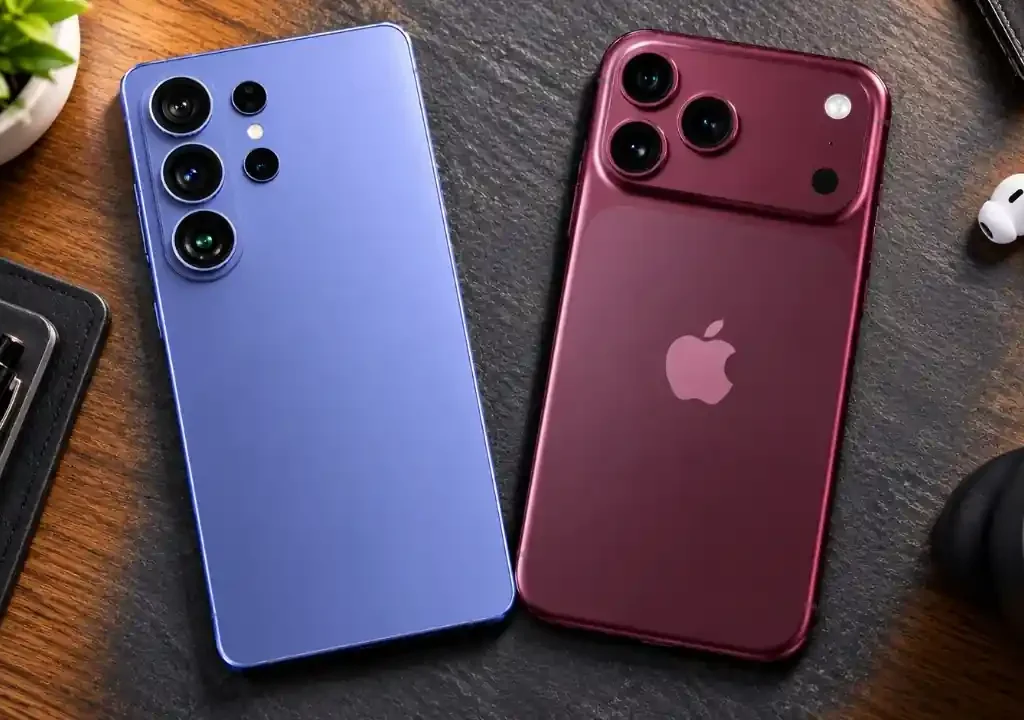
Are consumers paying top tier prices for genuine hardware innovation, or are marketing teams selling incremental upgrades disguised as revolutions?
Silicon fabrication nodes indicate the physical gate size inside processors, where smaller nanometer ratings pack more transistors to boost speed while cutting battery draw.
A variable mechanical aperture acts like a human eye’s pupil, physically widening or constricting glass blades to adjust light intake naturally rather than simulating depth via software blur.
Optical Physics Meets Computational Silicon
Apple shifted away from static glass by equipping the primary 48MP Fusion camera with physical aperture blades.
Consequently, the lens transitions mechanically between f/1.48, f/1.8, f/2.8, and f/4.0.
This physical shutter mechanism produces creamy optical bokeh and sharp edge-to-edge clarity in group frames without relying on artificial digital clipping.
Meanwhile, Samsung counters with sheer resolution via an upgraded 200MP primary sensor.
The South Korean flagship relies heavily on 16-in-1 pixel binning algorithms alongside dual optical telephoto modules rated at 3x (10MP) and 5x (50MP).
Furthermore, Samsung retains exclusive dominance in extreme zoom ranges past 30x and native 8K video recording at 30fps.
However, Apple’s native manual shutter controls and ProRes log flexibility appeal far more to professional studio workflows.
2nm A20 Pro Against Snapdragon 8 Elite Gen 5
Under the hood, silicon architecture diverges into two contrasting manufacturing approaches.
Apple deployed the commercial 2nm A20 Pro processor, boasting 50% more memory bandwidth alongside dedicated hardware accelerators for on-device neural tasks.
In sustained thermal stress tests, Apple’s platform sustained peak graphical output longer during 3DMark Solar Bay runs.
Conversely, the Galaxy S26 Ultra packs Qualcomm’s customized Snapdragon 8 Elite Gen 5, clocked up to an aggressive 4.74 GHz on primary Oryon performance cores.
Everyday app launching, split-screen multitasking, and system navigation feel blisteringly responsive across both operating systems.
Nevertheless, the 2nm fabrication process grants the Cupertino device superior thermals under intense 3D gaming sessions.
| Feature Specification | Samsung Galaxy S26 Ultra | Apple iPhone 18 Pro Max |
|---|---|---|
| Processor | Snapdragon 8 Elite Gen 5 (3nm) | Apple A20 Pro (2nm) |
| Display Panel | 6.9-inch Dynamic LTPO AMOLED, 120Hz | 6.9-inch Super Retina XDR OLED, 120Hz |
| Peak Brightness | 2,600 nits | 3,000 nits |
| Primary Camera | 200MP (f/1.7, 24mm) | 48MP Variable Aperture (f/1.48–f/4.0) |
| Telephoto Setup | 10MP (3x optical) + 50MP (5x periscope) | 48MP (4x tetraprism optical) |
| Battery Capacity | 5,000mAh | 5,391mAh |
| Charging Speeds | 60W Wired / 25W Qi2 Wireless | 35W Wired / 25W MagSafe |
| Weight & Build | 214g (7.55 oz), Armor Aluminum & Glass | 249g (8.78 oz), Grade 5 Titanium |
| Input Tech | Integrated S Pen Stylus | Pro Camera Controls |
| Base Global Price | $1,299 / €1,399 / £1,199 | $1,299 / €1,449 / £1,199 |
Display Ergonomics and Real World Stamina
Both flagships feature sprawling 6.9-inch OLED panels with buttery smooth 120Hz variable refresh rates.
Samsung incorporated an anti-reflective coating alongside automated Privacy Display hardware that narrows viewing angles to block wandering eyes in public transit.
Apple countered by pushing peak outdoor brightness up to 3,000 nits, making direct sunlight readability exceptional.
However, carrying these giants creates distinct tactile experiences in hand.
Samsung engineered a chassis weighing 214g (7.55 oz), saving significant pocket bulk over time.
In contrast, Apple’s 249g (8.78 oz) structure quickly induces hand fatigue during extended one-handed typing.
Battery metrics flip the narrative back in Apple’s favor.
The iPhone’s 5,391mAh pack combined with iOS optimization delivered 19 hours and 20 minutes in standardized active usage tests.
Samsung’s 5,000mAh battery tapped out at 16 hours and 22 minutes, leaving a distinct 3-hour endurance deficit.
Even so, Samsung remedies depletion faster with 60W wired charging, hitting a 75% top-up in just 30 minutes.
The Bigger Picture
This clash reflects a decisive divergence in flagship product philosophies across global supply chains.
Apple prioritizes closed-loop efficiency, cinematic precision, and battery preservation to retain users within its expanding hardware ecosystem.
Samsung builds an uncompromising Swiss Army knife, integrating desktop productivity via DeX, hardware stylus inputs, and versatile zoom focal lengths.
As component pricing climbs, both manufacturers are forcing buyers to evaluate day-to-day utility over hollow spec-sheet victories.
An Unfiltered Take
If your primary buying criteria centers on unmatched battery endurance and reliable point-and-shoot portrait photography, the iPhone 18 Pro Max justifies its steep $1,299 entry ticket.
Yet, calling Apple the clear winner ignores severe ergonomic penalties.
Holding a 249g brick every single day gets old fast.
Samsung delivers a noticeably lighter body, the productivity utility of the S Pen, and superior fast charging without sacrificing screen real estate.
The spec sheet paints Apple as the silicon king, but Samsung’s daily ergonomics and display tech make it the more versatile companion for power users.
- K.K., Founder of TechKomo