Pocket filmmakers are dumping their heavy mirrorless rigs as the Osmo Pocket 4P vs Vivo X500 Pro Max cinematic battle pushes mobile video production into uncharted territory.
- Dual-camera mechanical stabilization goes head-to-head against Zeiss-tuned computational framing.
- Hardware brings true 10-bit D-Log 2 color profiles while mobile chips counter with 8K raw sensor readout.
- Physical gimbal motors eliminate rolling shutter artifacts that still challenge handheld flagship smartphones.
- Massive sensor scaling and dedicated telephoto glass blur the line between creator gear and pocket phones.
Can a smartphone camera truly dismantle the cinematic monopoly of a motorized 3-axis gimbal?
Cinematic video requires wide dynamic range, organic motion blur, and precise color grading latitude.
These traits separate professional movie-like framing from harsh digital smartphone clips.
TechKomo Disclaimer: Portions of the comparative performance metrics and release architectures below stem from supply-chain leaks and verified early hardware evaluations. Official production firmware and retail availability across global regions may introduce minor spec variations.
The Optics Showdown: Mechanical Gimbal Rig Meets 200MP Zeiss Glass
Dedicated cinema creators have long relied on physical hardware to dodge electronic warping.
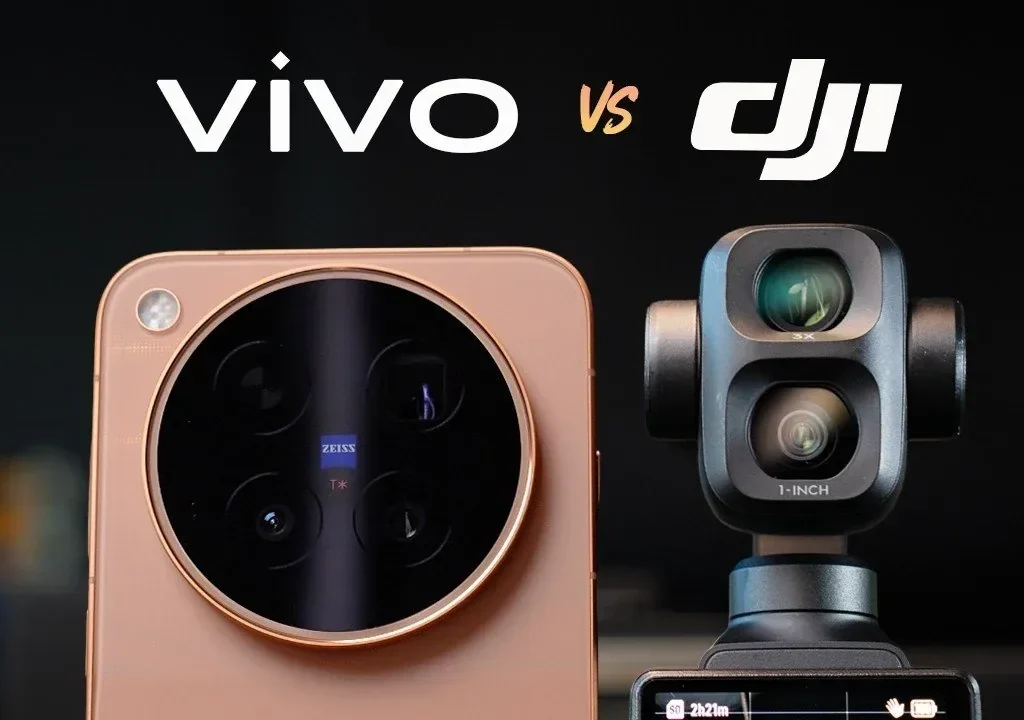
The pocket powerhouse brings a dual-lens module pairing a 1-inch CMOS primary sensor at a 20mm equivalent f/2.0 with a dedicated 1/1.28-inch 60mm telephoto lens at f/1.8.
This setup captures genuine optical compression without relying on pixel-binning trickery.
Meanwhile, the mobile titan counters with a massive 50MP Sony 1/1.28-inch main camera alongside an industry-leading 200MP Samsung HPB 1/1.4-inch periscope telephoto lens.
Zeiss T* anti-reflective coatings actively eliminate nasty lens flares when shooting directly into streetlights.
However, the dedicated handheld camera avoids digital cropping entirely by relying on its physical brushless motor assembly.
The result yields natural lens bokeh that computational portrait algorithms still struggle to replicate cleanly.
Stabilization and Motion: Brushless Motors vs Multi-Axis OIS
Walking shots expose the harsh reality of mobile filmmaking.
The pocket shooter employs an integrated 3-axis mechanical gimbal delivering rotational control accurate to ±0.005 degrees.
Because the entire optical housing moves mechanically, frames remain completely free of jittery edge artifacts.
In contrast, the flagship smartphone utilizes an advanced 3-degree hardware OIS combined with gyro-driven electronic stabilization.
This system works wonders during standard pans across open city streets.
Yet, aggressive footstep impacts still introduce subtle micro-jitters during fast tracking sequences.
The motorized gimbal effortlessly captures buttery low-angle tracking runs that mobile phones simply cannot mimic without external cages.
Color Science and Dynamic Range: 10-Bit D-Log 2 vs 8K Cinematic Profiles
Grading latitude decides whether a shot looks cheap or cinematic.
The dedicated video rig features an uncompressed 10-bit D-Log 2 profile capable of preserving up to 17 stops of dynamic range.
This lets editors pull nuanced highlight detail from blown-out skies in post-production.
Furthermore, it records crisp 4K slow-motion clips at 240fps on the main camera and 200fps on the 60mm lens.
On the other hand, the phone packs a beastly MediaTek Dimensity 9600 Pro 3nm processor capable of real-time multi-exposure merging.
It captures rich 8K video at 30fps and custom 4K cinematic movie modes with instant LUT application.
For instant turnarounds, the smartphone generates vivid HDR video ready for immediate social distribution.
Nevertheless, colorists will prefer the flat logarithmic profiles of the dedicated tool for complex color grading workflows.
| Specification Feature | DJI Osmo Pocket 4P | Vivo X500 Pro Max |
|---|---|---|
| Primary Camera Sensor | 1-inch CMOS (20mm f/2.0) | 50MP 1/1.28-inch LYT (f/1.57) |
| Secondary Telephoto Lens | 1/1.28-inch (60mm f/1.8, 3x optical) | 200MP HPB Periscope (85mm, 1/1.4-inch) |
| Processor Platform | Custom DJI V4 Neural ISP Engine | MediaTek Dimensity 9600 Pro (3nm) |
| Display Interface | 2.4-inch Rotatable OLED Touchscreen | 6.85-inch 144Hz LTPO AMOLED (QHD+) |
| Maximum Video Resolution | 4K at 240fps (Slow-Mo) / 4K at 60fps | 8K at 30fps / 4K at 120fps |
| Color Depth & Profiles | 10-bit D-Log 2, D-Log M, HLG | 10-bit Log, HDR10+, Dolby Vision |
| Battery Capacity & Life | 1545mAh (Up to 210 mins run-time) | 8000mAh (90W Wired / 40W Wireless) |
| Stabilization System | 3-Axis Mechanical Gimbal (±0.005°) | Advanced 3° OIS + EIS System |
| Weight & Portability | 230g / 8.11 oz | 225g / 7.94 oz |
| Global Retail Pricing | $839 (approx. ₹69,990 / €775 / £665) | $1,080 (approx. ₹89,990 / €995 / £855) |
Real-World Workflow: Battery Endurance, Audio, and Production Speed
Filming on location quickly tests hardware reliability.
The dedicated gimbal unit weighs 230g / 8.11 oz and runs for 210 minutes of continuous recording.
Its 1545mAh cell charges from zero to 80% in just 18 minutes.
Additionally, its 2.4-inch OLED display spins physically to toggle between horizontal cinema and vertical reels instantly.
Seamless integration with wireless transmitters delivers broadcast-grade audio without requiring cumbersome external dongles.
Conversely, the smartphone sports a massive 8000mAh battery and a gorgeous 6.85-inch 144Hz AMOLED screen.
The phone makes reviewing framing and editing in mobile suites an absolute breeze.
Yet, prolonged 4K recording generates thermal throttling that caps sustained high-bitrate capture on phones.
The specialized camera stays cooler for longer shoots thanks to passive chassis ventilation.
The Bigger Picture
This clash highlights a seismic shift across the mobile imaging industry.
Smartphone giants are stuffing astronomical 200MP sensors into pocket slabs to challenge dedicated cameras.
Simultaneously, standalone camera makers are integrating multi-lens telephoto systems and rapid phone-sync workflows to protect their creative turf.
This escalating arms race forces rivals like Sony, Apple, and Canon to rethink their compact video strategies altogether.
Unfiltered Opinion
Computational video has achieved astonishing visual clarity, but pure physics still reigns supreme.
The smartphone is an incredible all-in-one powerhouse that lets you shoot, edit, and publish cinematic clips instantly.
If your primary goal is rapid social storytelling, the smartphone saves you from carrying two devices.
However, if you demand authentic motion blur, flawless walking pans, and zero stabilization warping, the dedicated gimbal camera is irreplaceable.
The lack of digital edge sharpening and the luxury of uncompressed log grading make the dedicated tool well worth its standalone price tag.
- K.K., Founder of TechKomo